
Vehicle Chemical Spill Remediation in Edmonton
Inspection-led assessment and interior remediation for accepted, identifiable chemical spills affecting vehicle carpet, underlay and concealed areas.
We assess what was spilled, where it may have travelled and whether affected materials can be restored or require replacement.
REQUEST A CHEMICAL-SPILL ASSESSMENT
Insurance claim already opened? Include your claim and adjuster information with your request.
A Chemical Spill Just Happened—What Should You Do?
The product and spill information will help determine whether the vehicle can be safely assessed and whether it falls within our service scope.
Do This
Keep the product container and label.
Locate the Safety Data Sheet if one is available.
Photograph the product and affected area.
Record approximately how much spilled and when it happened.
Note any odour, residue, staining or warning lights.
Follow the manufacturer’s safety and first-aid instructions.
Avoid This
Do not mix the spill with other cleaning chemicals.
Do not saturate the area with water unless the product instructions specifically require it.
Do not use heat to accelerate drying.
Do not operate or enter the vehicle if doing so may be unsafe.
Do not discard the product information before the assessment.
If the product presents an immediate health, fire or inhalation hazard, contact emergency services, poison control or the product manufacturer before contacting us.
The Visible Spill May Be Only Part of the Problem
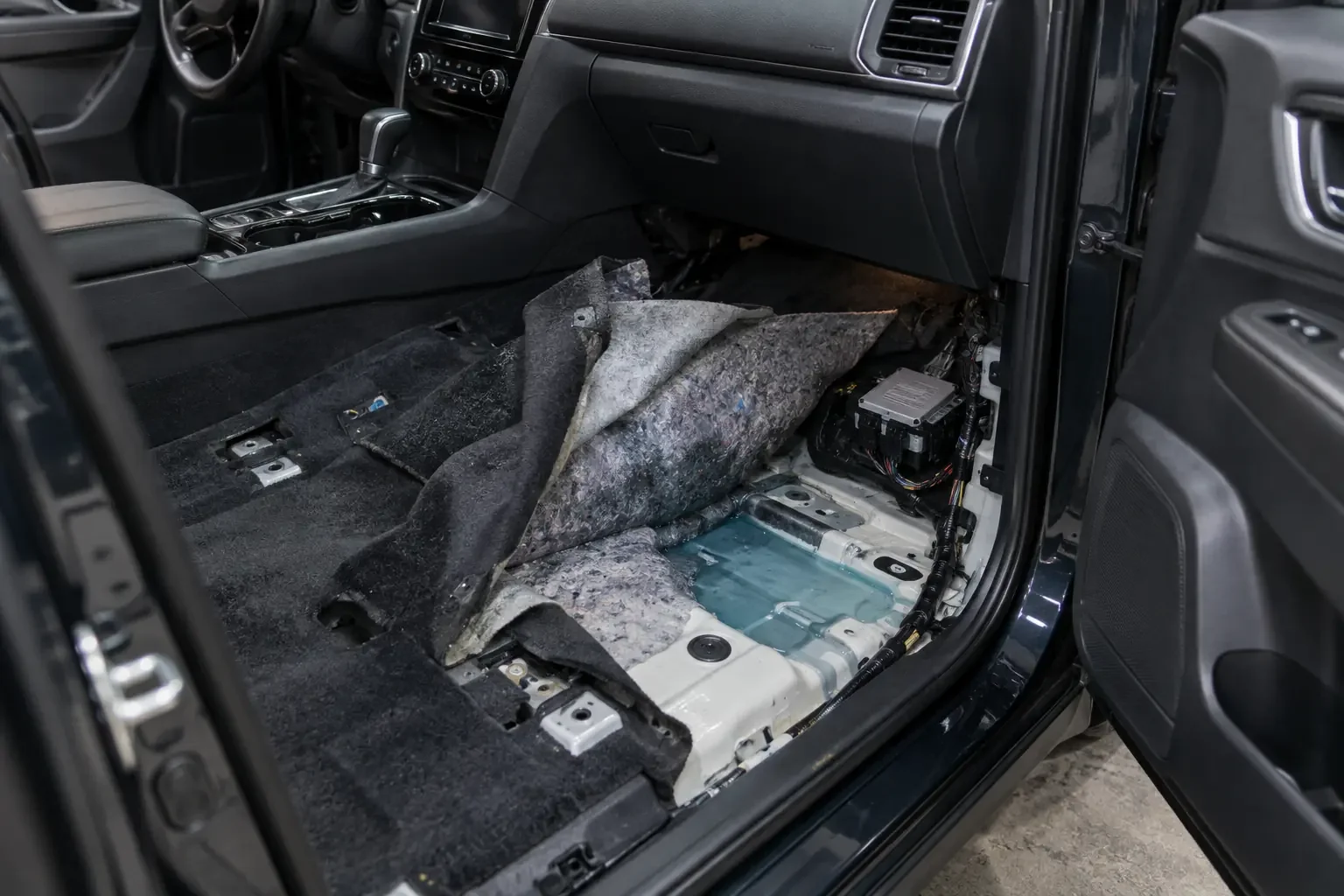
Vehicle carpet can conceal attached foam, underlay, wiring routes, mounting points and recessed floor areas.
Even when a spill appears limited to one section of carpet, liquid may travel:
Beneath seats and centre consoles
Into carpet underlay or attached padding
Along carpet edges and seams
Around seat mounting points
Along wiring routes
Into recessed floor areas
Beneath trim and interior panels
Surface extraction may improve the visible area without addressing chemical liquid or residue retained underneath it.
The appropriate scope depends on what was spilled, the quantity involved, the construction of the affected materials and how far the liquid may have travelled.
Is Your Chemical Spill Within Our Scope?
The spilled substance must be identified before we can determine whether the vehicle can be safely accepted. Product-label photographs, manufacturer information or a Safety Data Sheet may be required.
We May Accept
Following assessment, we may accept identifiable spills involving:
Household or commercial cleaning products
Detergents and concentrated cleaning solutions
Deodorizers and treatment products
Certain automotive fluids
Water-based chemical solutions
Known substances affecting carpet or underlay
Accepted products that have travelled beneath interior components
Outside Our Scope
We do not accept:
Unknown or unidentified substances
Asbestos or asbestos-containing material
Illicit drugs or drug-manufacturing contamination
Explosive, radioactive or highly reactive substances
Chemical-laboratory contamination
Products requiring hazardous-material licensing beyond our operating scope
Acceptance is determined individually according to the product, quantity, concentration, affected materials and required handling procedures.
How Chemical-Spill Remediation Works
Every project is adapted to the identified substance, affected materials and vehicle condition. The complete scope may change when concealed areas become accessible.
1. Product and Spill Assessment
We review the product information, approximate quantity, spill location, available Safety Data Sheet and photographs to determine whether the vehicle falls within our service scope.
2. Preliminary Scope and Estimate
We explain the recommended investigation, expected access requirements, estimated labour and preliminary cost based on the information available before service.
4. Concealed-Area Inspection and Remediation
Once access is created, we document where the chemical travelled and evaluate the carpet, underlay, vehicle floor, wiring routes and surrounding components. Accessible affected areas are treated according to the identified substance and materials involved.
3. Professional Mechanical Access
When seats, carpet, consoles or other components must be removed, we coordinate the required work. Regulated mechanical removal and reinstallation are performed by a qualified automotive technician through a third-party AMVIC-licensed automotive repair business.
5. Drying, Reassessment and Reassembly
Treated areas are dried and reassessed. Materials that cannot be reliably restored may be recommended for replacement before professional reassembly and final documentation.
If concealed findings materially change the recommended scope, they are documented and communicated before work outside the approved scope proceeds.
Can the Carpet and Underlay Be Restored?
That depends on the chemical involved, the amount absorbed and how the vehicle’s carpet assembly is constructed.
Some vehicles use padding or underlay that can be accessed separately. Others have foam or underlay bonded directly to the carpet. When bonded materials become substantially saturated, reliable cleaning, rinsing and drying may be limited by the material’s construction.
Replacement May Be Recommended When:
Carpet or bonded underlay is extensively saturated
Chemical remains trapped within internal material layers
The material has softened, hardened, discoloured or deteriorated
Odour or residue remains after reasonable treatment
Continued treatment could damage the material
Restoration would not provide a reasonable or dependable outcome
Replacement is not automatically required after every spill. We evaluate the affected material after access is created and explain the available restoration or replacement options before proceeding outside the approved scope.
Approximately 2 litres of Zep Concentrated Purple Degreaser spilled inside this vehicle and travelled beneath the visible carpet.
What If the Spill Reached Wiring or Electronics?
Chemical migration near wiring, connectors, control modules or other electrical components requires careful inspection.
Once approved access is created, we document whether accessible components appear:
Dry and unaffected
Surrounded by chemical liquid
Directly contacted or saturated
Affected by visible residue or material deterioration
In need of further inspection by an automotive repair professional
Cotton Soft Detailing can document and clean accessible interior surfaces within the approved remediation scope. We do not diagnose internal electrical damage or guarantee the future operation of wiring, modules or electronic systems.
When chemical contact or electrical damage is suspected, further evaluation by an appropriate automotive repair professional may be recommended.
Real Project Finding: In a spill involving approximately 2 litres of Zep Concentrated Purple Degreaser, the chemical travelled from the front-passenger area toward the passenger-rear floor. According to the qualified automotive technician working through the third-party AMVIC-licensed automotive repair business, the accessible wiring harnesses and electronic modules appeared dry and were not visibly saturated. No chemical residue was observed on those components, and no related electrical issues were identified during the inspection. Based on the conditions observed, replacement of the accessible wiring harnesses and modules was not expected to be necessary.
Service Time, Pricing and Important Limitations
Every chemical-spill project is assessed according to the identified substance, affected materials, required access and findings discovered during the service.
Service Time
Some chemical-spill projects may be completed within several days. Projects involving extensive disassembly, controlled drying, replacement carpet or vehicle-specific parts may require additional time or multiple weeks.
Service time can be affected by:
Extent of chemical migration
Required mechanical access
Material condition
Drying and reassessment requirements
Findings discovered after disassembly
Parts availability and delivery
Scheduling of third-party services
Insurance authorization or customer decisions
We provide an estimated timeline, but completion dates cannot be guaranteed.
Condition-Based Pricing
Pricing may account for:
Product and contamination involved
Quantity and extent of migration
Vehicle size and interior construction
Remediation labour
Mechanical disassembly and reassembly
Required PPE and disposal procedures
Controlled drying and reassessment
Replacement carpet, underlay or other parts
Additional automotive or specialty services
Preliminary estimates are based on the information available before service. If concealed findings materially change the recommended scope, they are documented and communicated before additional work proceeds.
Important Limitations
Chemical exposure may cause permanent staining, odour, corrosion, material deterioration or electrical damage before service begins.
Some substances may enter seams, enclosed structural cavities or other areas that cannot be safely accessed without destructive procedures. Remediation cannot guarantee removal from every inaccessible area or prevent future corrosion, material failure or electrical problems.
All work is limited to the approved scope and the areas that can be safely and reasonably accessed.
Frequently Asked Questions
-
No. The substance must be identified before we can determine whether it can be safely handled within our service scope. Product-label photographs, manufacturer information or a Safety Data Sheet may be required.
-
Not necessarily. The required access depends on where the chemical travelled and which materials may have been affected. We recommend mechanical access only when it is justified by the vehicle’s condition and approved scope.
-
No. Carpet or bonded underlay may require replacement when the chemical cannot be reliably removed, the material has deteriorated or restoration would not provide a dependable outcome.
-
We document the visible condition of accessible wiring, connectors and modules after approved access is created. Internal electrical diagnosis and repair must be performed by an appropriate 3rd party automotive repair professional/facility.
-
We can provide estimates, photographs, findings, invoices and supporting documentation for insurance review. When authorized, we can also communicate documented findings to the insurer or adjuster. Coverage and reimbursement decisions remain with the insurance provider.
-
Pricing is based on the approved scope and may include remediation labour, required mechanical access, drying, replacement materials, vehicle-specific parts, disposal requirements and third-party services.
-
The newly accessible condition is documented and communicated. If the findings require work outside the approved scope, a revised recommendation or estimate is provided before that additional work proceeds.
Tell Us What Spilled and Where It Travelled
You do not need to determine the required service yourself.
Submit the product name, approximate quantity, affected areas, vehicle information and available photographs. We will review the information and advise whether the spill appears to fall within our service scope.
If an insurance claim is already open, include the claim number, insurer and adjuster information with your request.
Product-label photographs or a Safety Data Sheet may be required before the vehicle can be accepted.